
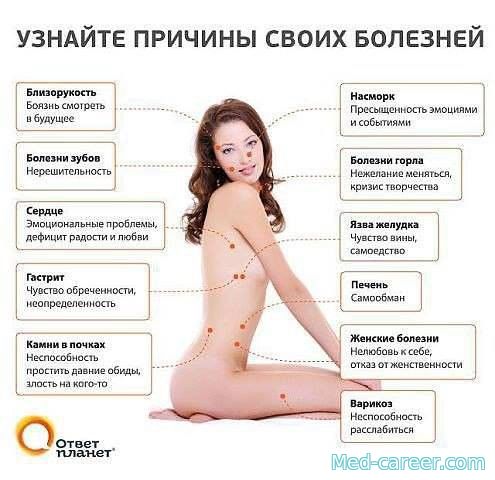
TABLE OF DISEASES CORRESPONDING TO PSYCHOLOGICAL DISORDERS
Recently, psychologists and doctors have begun to collaborate in the treatment of diseases that were once considered somatic (physical).
There are several reasons for the onset of diseases:
- Genetic or constitutional predisposition of the organ
- Stress, psychological trauma
- Internal conflict
Rephrasing a well-known saying, one could say, "Tell me what you are sick with, and I will tell you who you are."
The table below provides the main psychological reasons for the onset of diseases. It is worth noting that this is not a universal table and it will not replace traditional medicine, but it can serve as a good aid in achieving harmony of spirit and body.
Table of correspondence of diseases to psychological disorders
Alcoholism, drug addiction.
- Unable to cope with something. Terrible fear. Desire to get far away from everyone and everything. Unwillingness to be here.
- Feeling of futility, inadequacy. Rejection of one's own personality. Allergy.
- Who can you not stand? Denial of one's own power.
- Protest against something that cannot be expressed.
- It often happens that the parents of an allergic person frequently argued and had completely different views on life.
Appendicitis. Fear. Fear of life. Blocking everything good.
Insomnia.
- Fear. Distrust of the life process. Guilt.
- Escape from life, unwillingness to acknowledge its shadow sides.
Vegetative dystonia. Infantilism, low self-esteem, tendency to doubt and self-blame.
Weight: problems.
Excessive appetite. Fear. Self-defense. Distrust of life. Feverish overindulgence and getting rid of self-hatred.
Obesity.
- Hypersensitivity. Often symbolizes fear and the need for protection. Fear can serve as a cover for hidden anger and unwillingness to forgive. Trust in oneself, in the very process of life, refraining from negative thoughts — these are ways to lose weight.
- Obesity is a manifestation of the tendency to protect oneself from something. A feeling of inner emptiness often awakens appetite. Eating provides many people with a sense of acquisition. But emotional deficiency cannot be filled with food. A lack of trust in life and fear of life circumstances plunge a person into an attempt to fill the emotional void with external means.
Lack of appetite. Denial of personal life. Strong feelings of fear, self-hatred, and self-denial.
Thinness. Such people do not like themselves, feel insignificant compared to others, fear rejection. And therefore, they try to be very nice.
Cellulite (inflammation of subcutaneous tissue). Accumulated anger and self-punishment. Forcing oneself to believe that nothing bothers her.
Inflammatory processes. Fear. Rage. Inflamed consciousness. The conditions you have to see in life cause anger and disappointment.
Hirsutism (excessive hair growth in women). Hidden anger. Usually, the cover used is fear. A tendency to blame. Often: unwillingness to engage in self-education.
Eye diseases. The eyes symbolize the ability to see the past, present, and future clearly. Perhaps you do not like what you see in your own life.
Astigmatism. Rejection of one's own "self." Fear of seeing oneself in the true light.
Myopia. Fear of the future.
Glaucoma. Stubborn unwillingness to forgive. Old grievances weigh heavily. Being crushed by all this.
Hyperopia. Feeling out of this world.
Cataract. Inability to look forward with joy. A foggy future.
Conjunctivitis. An event has occurred in life that caused intense anger, and this anger is intensified by the fear of reliving that event.
Blindness, retinal detachment, severe head injury. Harsh judgment of another person's behavior, jealousy combined with contempt, arrogance, and rigidity.
Dry eyes. Evil eyes. Unwillingness to look with love. I would rather die than forgive. Sometimes a manifestation of schadenfreude.
Barley.
- Occurs in a very emotional person who cannot cope with what he sees.
- And who feels anger and irritation when realizing that other people see the world differently. Head: diseases. Jealousy, envy, hatred, and grievances. Headaches.
- Underestimation of oneself. Self-criticism. Fear. Headaches occur when we feel inferior, humiliated. Forgive yourself, and your headache will disappear by itself.
- Headaches often occur from low self-esteem, as well as from low resistance even to minor stresses. A person complaining of constant headaches is literally made up of psychological and physical clamps and tension. The habitual state of the nervous system is to always be at the limit of its capabilities. And the first symptom of impending diseases becomes a headache. Therefore, doctors working with such patients initially teach them to relax.
- Loss of contact with one's true self. The desire to justify the inflated expectations of others.
- The desire to avoid any mistakes.
migraine.
- Hatred of coercion. Resistance to the flow of life.
- Migraines are created by people who want to be perfect, as well as by those who have accumulated a lot of irritation in this life.
- Sexual fears.
- Hostile envy.
- Migraine develops in a person who does not allow themselves to be themselves.
Throat: diseases.
- Inability to stand up for oneself. Swallowed anger. Creative crisis. Unwillingness to change. Throat problems arise from the feeling that we "have no right" and from the feeling of one's own inadequacy.
- The throat also represents the area of the body where all our creative energy is concentrated. When we resist change, we most often have throat problems.
- One must give oneself the right to do what one wants, without blaming oneself and without fearing to disturb others.
- Sore throat is always irritation. If accompanied by a cold, then, in addition, confusion.
Angina.
- You refrain from harsh words. You feel unable to express yourself.
- You feel anger because you cannot cope with a certain situation.
Laryngitis. Anger prevents speaking. Fear prevents expressing oneself. I am oppressed.
Tonsillitis. Fear. Suppressed emotions. Muffled creativity. Conviction of one's inability to speak for oneself and to independently meet one's needs.
Hernia. Broken relationships. Tension, burden, improper creative self-expression.
Childhood diseases. Belief in calendars, social concepts, and invented rules. Adults around behave like children.
Adenoids. A child who feels unwanted.
Childhood asthma. Fear of life. Unwillingness to be here.
Eye diseases. Unwillingness to see what is happening in the family.
Otitis (inflammation of the outer ear canal, middle ear, inner ear). Anger. Unwillingness to listen. Noise in the house. Parents are quarreling.
Nail-biting habit. Hopelessness. Self-criticism. Hatred for one of the parents.
Staphylococcus in children. Irreconcilable attitude towards the world and people from parents or ancestors.
Rickets. Emotional hunger. Need for love and protection.
Childbirth: deviations. Karmic.
Diabetes.
- Longing for the unfulfilled. Strong need for control. Deep sorrow. Nothing pleasant is left.
- Diabetes can be caused by the need to control, sadness, as well as the inability to accept and assimilate love. A diabetic cannot stand attachment and love, although they crave it. They unconsciously reject love, despite experiencing a strong need for it on a deep level. Being in conflict with oneself, in self-rejection, they cannot accept love from others. Achieving inner peace, openness to accepting love, and the ability to love is the beginning of recovery from the disease.
- Attempts to control, unrealistic expectations of universal happiness, and sorrow to the point of hopelessness that it is unattainable. Inability to live one's life because one does not allow (or cannot) to rejoice and enjoy one's life events.
Respiratory diseases.
- Fear or refusal to inhale life deeply. Not recognizing one's right to occupy space or even to exist.
- Fear. Resistance to change. Distrust of the process of change. Asthma.
- Inability to breathe for one's own good. Feeling overwhelmed. Holding back tears. Fear of life. Unwillingness to be here.
- A person with asthma feels that they have no right to breathe for themselves. Asthmatic children are usually children with a highly developed conscience. They take all the blame upon themselves.
- Asthma arises when there are suppressed feelings of love in the family, suppressed crying, the child experiences fear of life and does not want to live anymore.
- Asthmatics express more negative emotions, are more often angry, offended, harbor resentment and a desire for revenge compared to healthy people.
- Asthma and lung problems can be caused by an inability (or unwillingness) to live independently, as well as a lack of living space. Asthma, desperately holding back incoming air flows from the outside world, indicates a fear of openness, sincerity, and the necessity to accept the new that each day brings. Gaining trust in people is an important psychological component that contributes to recovery.
- Suppressed sexual desires.
- Wants too much; takes more than necessary and gives with great difficulty. Wants to seem stronger than they are and thus evoke love for themselves.
Sinusitis.
- Suppressed self-pity.
- Prolonged situation of "everyone against me" and inability to cope with it.
Runny nose. A plea for help. Internal crying. You are a victim. Non-recognition of one's own worth.
Nasopharyngeal discharge. A child's cry, internal tears, feeling like a victim.
Nosebleeds. Need for recognition, desire for love.
Sinusitis. Irritation caused by one of the close ones.
Gallstone disease.
- Bitter thoughts. Heavy thoughts. Curses. Pride.
- Look for the bad and find it, blame someone.
Stomach diseases.
- Terror. Fear of the new. Inability to assimilate the new. Not knowing how to assimilate a new life situation.
- The stomach reacts sensitively to our problems, fears, hatred towards others and ourselves, dissatisfaction with ourselves and our fate. Suppressing these feelings, unwillingness to admit them to oneself, trying to ignore and "forget" them instead of understanding, realizing, and resolving them can lead to various stomach disorders.
- Stomach functions are disrupted in people who react shamefully to their desire for help or expressions of love from another person, the desire to lean on someone. In other cases, conflict is expressed in feelings of guilt for wanting to forcibly take something from another. The reason explaining why stomach functions are so vulnerable to such conflict is that food represents the first obvious satisfaction of the receptive-collective desire. In a child's mind, the desire to be loved and the desire to be fed are deeply connected. When, at a more mature age, the desire to receive help from another causes shame or shyness, which is often the case in a society where independence is the main value, this desire finds regressive satisfaction in an increased craving for food. This craving stimulates stomach secretion, and chronic increases in secretion in a predisposed individual can lead to ulcer formation.
Gastritis.
- Prolonged uncertainty. Feeling of doom.
- Irritation.
- Strong outburst of anger in the recent past.
Heartburn.
- Fear. The pressure of fear.
- Heartburn, excess stomach acid indicates repressed aggressiveness. The solution to the problem at the psychosomatic level is seen as transforming the forces of suppressed aggression into active engagement with life and circumstances.
Stomach and duodenal ulcers.
- Fear. Firm belief that you are defective. We fear that we are not good enough for our parents, bosses, teachers, etc. We literally cannot digest what we represent. We constantly try to please others. It does not matter what position you hold at work, you may completely lack a sense of self-worth.
- Almost all patients suffering from ulcers have a deep internal conflict between the desire for independence, which they highly value, and the need for protection, support, and care instilled since childhood.
- These are people trying to prove their necessity and irreplaceability to everyone.
- Envy.
- People with ulcer disease are characterized by anxiety, irritability, heightened diligence, and an acute sense of duty. They tend to have low self-esteem accompanied by excessive sensitivity, shyness, touchiness, self-doubt, and at the same time, heightened demands on themselves, and paranoia. It has been noted that these people tend to do significantly more than they can realistically handle. They typically have a tendency to actively overcome difficulties combined with strong internal anxiety.
- Anxiety, hypochondria.
- Suppressed feelings of dependency.
- Irritation, resentment, and at the same time helplessness from attempts to change oneself to fit someone else's expectations.
Teeth: diseases.
- Prolonged indecision. Inability to recognize ideas for subsequent analysis and decision-making. Loss of the ability to confidently immerse oneself in life.
- Fear.
- Fear of failure, to the point of losing faith in oneself.
- Instability of desires, uncertainty in achieving the chosen goal, awareness of the insurmountability of life's difficulties.
- The problem with teeth tells you that it is time to take action, specify your desires, and start implementing them.
Gums: diseases. Inability to follow through on decisions. Lack of clearly expressed attitude towards life.
Bleeding gums. Lack of joy regarding decisions made in life.
Infectious diseases. Weakness of the immune system.
- Irritation, anger, annoyance. Lack of joy in life.
Bitter.
- Trigger mechanisms are irritation, anger, annoyance. Any infection indicates an unresolved emotional discord. Weak resistance of the body, which is compounded by infection, is associated with a disturbance of emotional balance.
- Weakness of the immune system is caused by the following reasons:
- Lack of love for oneself;
- Low self-esteem;
- Self-deception, betrayal of oneself, hence the absence of emotional peace;
- Hopelessness, gloom, lack of zest for life, suicidal tendencies;
- Internal discord, contradictions between desires and actions;
- The immune system is related to self-identity — our ability to distinguish our own from others, to separate "I" from "not I."
- Fear of getting rid of everything outdated and unnecessary.
- A person makes hasty conclusions about reality, rejecting it entirely if only part of it does not suit them.
- Irritability due to the inability to integrate contradictory aspects of reality.
- Fear of not fitting into the allotted time.
- Anger in the past. Burdened feelings. Inability to get rid of accumulated problems, grievances, and emotions. The joy of life drowns in anger and sadness.
- Fear of separation.
- Suppressed fear. Must do an unloved job. Need to urgently finish something to receive certain material benefits.
- Unwillingness to part with outdated thoughts. Getting stuck in the past. Sometimes in sarcasm.
- Constipation indicates an excess of accumulated feelings, ideas, and experiences that a person cannot or does not want to part with, unable to make room for the new.
- Tendency to dramatize some event in their past, inability to resolve that situation (complete the gestalt).
- Infantilism, low self-esteem, tendency to doubt and self-blame.
- Anxiety, hypochondria.
- Tightness.
- Fear of losing something significant or ending up in a hopeless situation. Worry about the future.
- Unrealized ideas.
- Anxiety. Fear. Long-standing resentment in the soul. I am threatened. Fear of being hurt.
- Loss of self-perception. Refusal to take responsibility for one's own feelings.
- Fear of being hurt, wounded.
- Deadening of feelings and self. Refusal to take responsibility for one's own feelings.
- Disagreement with oneself. Lack of self-love;
- Indication of a subconscious desire to repel others, not to allow oneself to be examined. (i.e., insufficient self-respect and acceptance of oneself and one's inner beauty)
- Unwillingness to see other sides of the issue. Stubbornness. Lack of flexibility.
- Acts as if the troubling situation does not bother them at all.
- Irreconcilable antagonism. Mental breakdowns.
- Uncertainty about one's future.
- Feeling unloved. Criticism, resentment.
- Cannot say "no" and blame others for exploiting them. For such people, it is important to learn to say "no" when necessary.
- An arthritic person is one who is always ready to attack but suppresses this urge. There is a significant emotional influence on the muscular expression of feelings, which is extremely controlled.
- Desire for punishment, self-reproach. Victim state.
- A person is too strict with themselves, does not allow themselves to relax, cannot express their desires and needs. The "inner critic" is too well developed.
- Extremely critical attitude towards the manifestation of strength. Feeling that too much is being imposed on you.
- In childhood, these patients exhibit a certain style of upbringing aimed at suppressing the expression of emotions with an emphasis on high moral principles; it can be assumed that the constantly suppressed inhibition of aggressive and sexual impulses, as well as the presence of an excessively developed Superego, forms a maladaptive defensive psychological mechanism — repression. This defense mechanism involves the conscious displacement of disturbing material (negative emotions, including anxiety, aggression) into the subconscious, which in turn contributes to the emergence and escalation of anhedonia and depression. The prevailing psycho-emotional states are: anhedonia — chronic deficiency of the sense of pleasure, depression — a whole complex of sensations and feelings, of which low self-esteem and guilt are most characteristic for rheumatoid arthritis, a sense of constant tension, as the suppression mechanism hinders the free expression of psychic energy, the accumulation of internal, hidden aggressiveness or hostility. All these negative emotional states, when they exist for a long time, can cause dysfunctions in the limbic system and other emotion-generating areas of the hypothalamus, changing the activity in serotonergic and dopaminergic neurotransmitter systems, which in turn leads to certain shifts in the immune system, and together with the emotional dependence tension observed in these patients in the periarticular muscles (due to constantly suppressed psychomotor excitation) can serve as a psychological component of the entire mechanism of rheumatoid arthritis development.
- Fear due to money. Lack of financial support.
- Fear of poverty, material hardship. Forced to do everything alone.
- Fear of being used and getting nothing in return.
- Feeling of guilt. Attention is focused on everything that is in the past. "Leave me alone."
- Conviction that no one can be trusted.
- Lack of joy. Lack of movement of thought.
- Inability to listen to one's own needs.
- Resistance. Tension. Refusal to see the good.
- Frequent disappointments due to sharp criticism.
- Staying in a situation you hate. Disapproval.
- Feeling overwhelmed and crushed by work.
- Inability to relax due to feelings of guilt when receiving pleasure.
- Overconfidence — in the sense that you are ready to take on too much. So much that you cannot bear.
- There is a direct connection between feelings of anxiety, impatience, suspicion, and the risk of developing hypertension.
- Due to overconfident desires to take on an unbearable load, to work without rest, the need to justify the expectations of those around you, to remain significant and respected in their eyes, and in connection with this the suppression of one's deep feelings and needs. All this creates corresponding internal tension. It is advisable for a hypertensive person to abandon the pursuit of the opinions of others and learn to live and love people primarily in accordance with the deep needs of their own heart.
- Emotion, reactively unexpressed and deeply hidden, gradually destroys the body. Patients with high blood pressure primarily suppress emotions such as anger, hostility, and rage.
- Hypertension can be caused by situations that do not give a person the opportunity to successfully fight for the recognition of their personality by others, excluding the feeling of satisfaction in the process of self-assertion. A person who is suppressed, ignored, develops a constant sense of dissatisfaction with themselves, which finds no outlet and forces them to "swallow resentment" daily.
- Chronically combative hypertensives have dysfunctions in the circulatory system. They suppress the free expression of dislike towards others due to a desire to be loved. Their hostile emotions boil but have no outlet. In youth, they may be brawlers, but with age, they notice that they repel people with their vindictiveness and begin to suppress their emotions.
- Gloom, uncertainty.
- You have killed the ability to create your life independently and influence the world.
- Deficiency of love in childhood. Defeatist mood: "It doesn't matter, nothing will work out."
- Depression. Sadness. Fear of experiencing life. You feel you are unworthy of living life to the fullest. Constant internal rejection of the situation.
- The lungs are the ability to take and give life. Problems with the lungs usually arise from our unwillingness or fear to live life to the fullest, or from the belief that we have no right to live fully. Those who smoke a lot usually deny life. They hide behind a mask of their sense of inadequacy.
- Disruption of lung function indicates that a person finds it hard to live, they are tormented by some pain, sadness. They feel despair and disappointment and do not want to live anymore. They may feel that they have been driven into a corner, deprived of the freedom to act.
- Nervous atmosphere in the family. Arguments and screams. Rare calm.
- One or several family members drive you into hopelessness with their actions.
- Hopelessness.
- Wastefulness due to selfishness, possessiveness.
- Harsh grievances against oneself, fate. Discontent with the country, government, world. Revenge.
- Defeatist mood. Excess of destructive ideas. Feeling overwhelmed. Neglect of oneself. Feeling anxious. Acute emotional hunger. Anger directed at oneself.
- A person experiences many unrealistic fears related to the material side of their life. A person is constantly on guard because they feel danger.
Stones. Can form in the gallbladder, kidneys, prostate. Typically appear in people who have long harbored heavy thoughts and feelings related to dissatisfaction, aggression, envy, jealousy, etc. A person fears that others will guess about these thoughts. A person is rigidly oriented towards their ego, will, desires, perfection, abilities, and intellect.
Cyst. Constantly replaying past grievances in the mind. Improper development.
Intestines: problems.
Anal bleeding (presence of blood in feces). Anger and disappointment. Apathy. Resistance to feelings. Suppression of emotions. Fear.
Hemorrhoids.
Constipation.
Irritable bowel syndrome.
Colic. Irritation, impatience, dissatisfaction with the environment.
Colitis. Uncertainty. Symbolizes the ability to easily part with the past. Fear of letting something slip from one's hands. Unreliability.
Flatulence.
Indigestion. Animal fear, horror, anxious state. Grumbling and complaints.
Belching. Fear. Too greedy an attitude towards life.
Diarrhea. Fear. Refusal. Running away.
Mucosa of the large intestine. Layering of outdated tangled thoughts clogs the channels for waste removal. You are treading in the sticky quagmire of the past.
Skin: diseases. Reflects what a person thinks of themselves, the ability to value themselves in the face of the surrounding world. A person is ashamed of themselves, places too much importance on the opinions of others. Rejects themselves as they are rejected by others.
Abscess (boil). Disturbing thoughts about grievances, neglect, and revenge.
Simple herpes. A strong desire to do everything poorly. Unexpressed bitterness.
Fungus. Outdated beliefs. Unwillingness to part with the past. Your past dominates your present.
Itching. Desires that contradict character.
Dissatisfaction. Regret. Desire to escape from the situation.
Neurodermatitis. A patient with neurodermatitis has a pronounced desire for physical contact, suppressed by parental restraint, hence they have disturbances in contact organs.
Burns. Anger. Internal boiling.
Psoriasis.
Acne.
Boil. A specific situation poisons a person's life, causing intense feelings of anger, anxiety, and fear.
Neck: diseases.
Exema.
Bones, skeleton: problems. A person values themselves only for being useful to others.
Arthritis.
Herniated intervertebral discs. Feeling that life has completely deprived you of support.
Spinal curvature. Inability to go with the flow of life. Fear and attempts to hold onto outdated thoughts. Distrust of life. Lack of wholeness of nature. No courage of convictions.
Lower back pain. Unfulfilled expectations in the realm of interpersonal relationships.
Radiculitis. Hypocrisy. Fear for money and the future.
Rheumatoid arthritis.
Back: diseases of the lower part.
Back: diseases of the middle part.
Back: diseases of the upper part. Lack of moral support. Feeling unloved. Suppressing the feeling of love.
Blood, veins, arteries: diseases.
Anemia. Deficiency of joy. Fear of life. Belief in one's own inadequacy deprives joy from life.
Arteries (problems). Problems with arteries — inability to enjoy life. Cannot listen to their heart and create situations associated with joy and fun.
Atherosclerosis.
Varicose veins.
Exaggeration of the seriousness of problems.
Hypertension or high blood pressure.
Hypotension or low blood pressure.
Hypoglycemia (decreased blood glucose levels). Suppression under the burdens of life. "Who needs this?"
Lung diseases.
Bronchitis.
Pneumonia (inflammation of the lungs). Despair. Fatigue from life. Emotional wounds that are not allowed to heal.
Tuberculosis.
Emphysema. You fear inhaling life deeply. You feel unworthy of life.
Lymph: diseases. A warning that one should refocus on the most important things in life: love and joy.
Adrenal glands: diseases.
Nervous system: diseases.
Neuralgia. Punishment for sinfulness. Torment of communication.
Paralysis. Fear. Horror. Avoiding a situation or person.
Resistance. Paralytic thoughts. Deadlock.
Multiple sclerosis. Rigidity of thinking, cruelty, iron will, lack of flexibility. Fear.
Epilepsy. Paranoia. Refusal of life. Feeling of intense struggle. Violence against oneself.
Legs: diseases. A program of self-destruction, dissatisfaction with oneself, the situation, one's position. For the sake of well-being, readiness to harm another or despise oneself if there is no well-being.
Thighs: diseases. Fear of moving forward in making major decisions. Lack of purpose.
Knees. Stubbornness and obstinacy. Inability to be.