
Acne is no longer a "teenage" problem: breakouts on the chin, cheeks or jawline bother people over 25, 30 and even 40. For adults it is especially unpleasant — it gets in the way of work, social life and self-confidence. Here is why acne appears in adulthood, what care suits this skin, what a cosmetologist can do and when you cannot do without a dermatologist.
Why adults get acne
The mechanism of acne is the same at any age: the sebaceous glands produce more sebum, dead skin cells build up faster and block the gland ducts, and in the clogged pores bacteria trigger inflammation. In adults, genetics, chronic infections and weakened immunity are added to this picture.
In the blog article "Skin Without Problems" Larysa Lonchar explains how it works. Under the influence of hormones, testosterone in particular (in women as well as men), the sebaceous glands become more active and keratinisation speeds up. If the gland openings are naturally narrow, they clog easily.
Up to 80% of young people aged 13 to 24 have acne, and for most of them it is relatively mild. But in some people, because of genetic factors, chronic infections or weakened immunity, acne can persist for decades — and affect careers and personal lives well into adulthood.
How to tell a cosmetic problem from an inflammatory one
A few closed pores, comedones and oily shine are a skin condition that home care and cleansing handle well. Many red, painful spots, pustules, deep nodules and the marks they leave behind are already an inflammatory process. It has to be calmed first, and a doctor decides what exactly to do.
Your plan depends on what dominates on your skin. For example, with active inflamed spots, facial cleansing as well as injection and laser procedures are not recommended — the inflammation has to be reduced first.
| Comedones, closed pores, oily shine | Active inflamed breakouts | Deep painful spots, scars | |
|---|---|---|---|
| What it is | a state of oily skin | inflammation in the pores | pronounced inflammation |
| Home care | sebum-regulating, gentle cleansing | anti-inflammatory, without harsh drying | as prescribed by a doctor |
| Facial cleansing | yes, combined | no, while inflammation is active | no |
| Peel | as the cosmetologist decides | anti-inflammatory — as the cosmetologist decides | as the doctor decides |
| Who to see | cosmetologist | cosmetologist with a medical degree | dermatologist together with a cosmetologist |
The table is a guide, not a diagnosis: where one condition ends and another begins is decided by a specialist during the examination.
Home care for acne-prone skin
Home care for acne has three jobs: gently remove excess sebum, calm inflammation and moisturise without clogging pores. Harsh cleansing and drying the skin out with alcohol-based products do harm: the skin is already stressed by chronic inflammation. It is best to choose products for your skin together with a cosmetologist.
Larysa Lonchar stresses that cleansing should be gentle but thorough: it should remove excess sebum and dust without injuring or irritating the skin. For oily, blemish-prone skin she uses the A line of the German cosmeceutical brand Dr.Belter. It includes a refreshing cleansing gel, a lotion that balances skin pH, a moisturising anti-inflammatory cream, bacteriostatic and cryogenic masks, a two-phase fluid with salicylic acid for spot application and even a sebum-regulating tinted cream.
Rules that apply to any product:
- Don't squeeze. Picking at spots leaves pigmentation or scars, and inflammation often spreads.
- Don't over-dry. Acne-prone skin can be dehydrated too; it needs moisture, just in light textures.
- Consistency beats the number of jars. Results come from a steady routine, not from switching products often.
- Follow all the recommendations. When acne treatment is prescribed, follow not only what to put on your face but also the advice on eating habits and lifestyle.
Skin type cannot be changed — it is determined by genetics. But with the right care, oily shine and enlarged pores become less noticeable. More in the article "Can You Change Your Skin Type?".
Which treatments a cosmetologist offers for acne
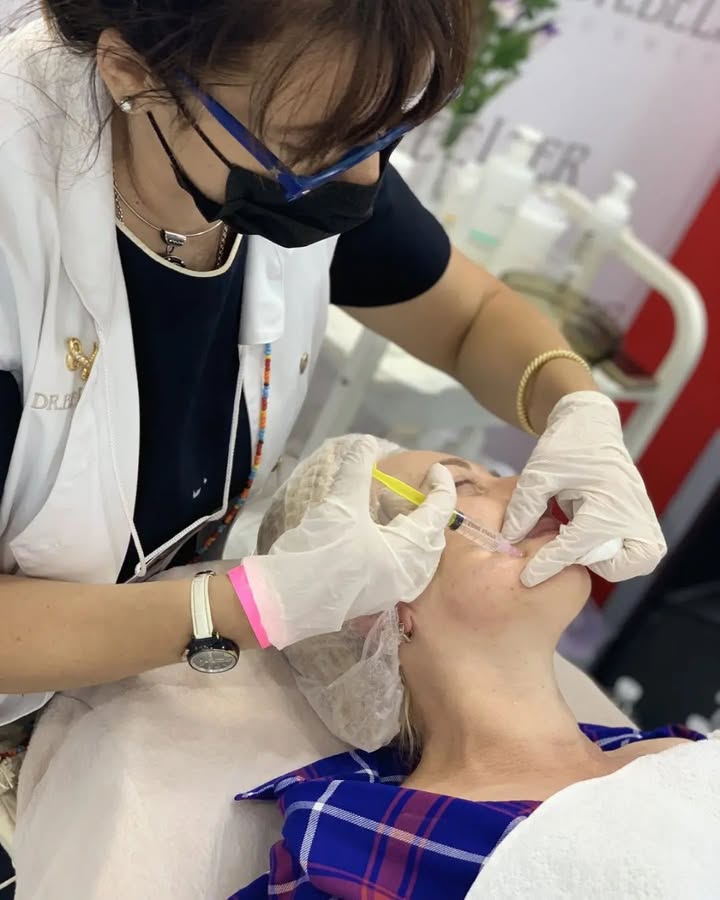
The main treatments for acne are facial cleansing, peels for acne and post-acne, and anti-inflammatory and sebum-regulating facial programmes. They are combined with home care and planned as a course. Depending on the skin, the cosmetologist may add mesotherapy, homeomesotherapy or carboxytherapy. What exactly and in what order is decided by the doctor during the examination.
Facial cleansing. Manual cleansing deals with breakouts and oily shine, but it is done by hand, so at Biotonika only heavily congested areas are cleaned manually. The rest is finished with an ultrasonic scrubber: it removes dead cells, cleans pores and helps normalise the sebaceous glands. The difference between types of cleansing is explained in "Facial Cleansing: Manual, Ultrasonic or Combined".
Peels. The clinic offers a dedicated peel for acne, post-acne and couperose. Peels are done once every 14 days as a course of no more than 3–5 sessions, followed by a break.
Facial programmes. At her seminars "Oily Skin: a Biological Approach" Larysa Lonchar demonstrated to cosmetologists an anti-inflammatory keratolytic facial with a peel for acne-prone skin, a sebum-regulating facial for oily seborrhoeic and sensitive skin, and a restoring one for oily dehydrated skin. The seminars also covered how to choose the type of cleansing for acne, couperose and demodicosis.
Injection methods. Mesotherapy is used, among other things, for acne and enlarged pores; homeomesotherapy with homeopathic preparations is used for acne and other skin problems. Carboxytherapy suits those concerned about acne and pores.
| Treatment | Price at Biotonika (October 2026) | Duration |
|---|---|---|
| Facial with cleansing | UAH 1,700 / 2,500 | 90 min |
| Peel for acne, post-acne, couperose | from UAH 1,300 | ≈ 30 min |
| Cosmetologist consultation | free with a procedure | — |
Current prices are on the facial cleansing and facial peel pages.
The bioregulatory approach: working with the cause
In bioregulatory cosmetology, acne is seen not as a local skin flaw but as a sign of a chronic inflammatory process in the body. So besides skincare and treatments, the consultation looks for the cause of the breakouts and builds an individual plan — with bioregulatory medicines, herbal therapy or autohaemotherapy. This way skincare and treatments work with the skin rather than against it.
Larysa Lonchar is a cosmetologist with a higher medical education and a specialisation in homotoxicology, working in cosmetology since 2000. She has used biological preparations, Heel in particular, in her practice for more than 20 years. At the consultation she looks carefully into the cause of the breakouts, discusses your health, lifestyle, previous treatments and current home care, and helps choose products for daily use.
Larysa Lonchar also teaches this approach to doctors: the master class "Acne — Physiological Treatment" covers the causes and types of acne, severity assessment, topical therapy and corneotherapy, Heel protocols and autohaemotherapy. The master class lasts 5 hours, is designed for doctors of all specialities and, as of October 2026, costs UAH 4,000; participants receive a certificate at the end.
Post-acne: what to do about the marks
Post-acne means the spots, red or dark marks and uneven texture left after inflamed breakouts. Work on them starts once new breakouts are under control. For this the clinic offers a peel for acne and post-acne and a peel for hyperpigmentation; the course and its combination with other treatments are chosen by the cosmetologist.
The less the skin is injured during a flare-up, the fewer marks remain. So the main rule for preventing post-acne is simple: don't squeeze spots and don't "burn" them with harsh products. The second rule is sun protection: after peels and acids the skin is vulnerable to UV, and without protection pigmentation can appear where the marks are. Apply sunscreen every morning, even in winter.
When you need a dermatologist
See a dermatologist if breakouts are numerous, deep and painful, leave scars, if acne has suddenly worsened for no obvious reason, or if skincare and treatments have not helped for several months. Oral medication — antibiotics, systemic retinoids — is prescribed only by a doctor. The best results come when a cosmetologist and a dermatologist work together.
Classical dermatology offers many anti-acne products, both oral and topical: antibacterial and drying preparations. During such treatment, peeling, irritation, redness and increased sensitivity to the sun are possible. This is where a cosmetologist helps: according to Larysa Lonchar, well-chosen care in the clinic and at home makes active therapy more effective and shortens it and the recovery period, extends remission and reduces the risk of relapse.
Don't prescribe yourself medication based on advice from the internet: such "treatment" often ends in complications that then have to be corrected.
Where to start
Start with a consultation: the cosmetologist will look at your skin, assess what dominates on it, review your current home care and advise which treatments you need and which are better postponed. Bring photos of the products you use and remember your previous treatments and how your skin reacted.
Larysa Lonchar's consultation is free with any procedure; if you cannot come in person, your skincare can be chosen at an online consultation. The key with acne is patience and consistency: as Larysa Lonchar writes, the winner is the one who has learned to take care of themselves and to be attentive and disciplined.
Questions and answers
Why do adults get acne?
The mechanism is the same as in teenagers: the sebaceous glands work harder, dead skin cells block their ducts, and bacteria trigger inflammation in the clogged pores. In some people, because of genetics, chronic infections or weakened immunity, the problem does not fade with age and can last for years.
Can I have a facial cleansing if I have acne?
Yes, but not always. Cleansing helps when closed pores and comedones dominate. If the skin has many active inflamed spots, cleansing is not recommended — the inflammation is calmed first. The cosmetologist decides on the type of cleansing and its timing during the examination.
Which facial cleansing is best for acne-prone skin?
Usually the combined one. At Biotonika only heavily congested areas are cleaned manually and the rest is finished with an ultrasonic scrubber, so the skin is less traumatised. Ultrasonic cleansing also helps normalise the work of the sebaceous glands.
Can I squeeze pimples myself?
It is better not to. Squeezing injures the skin and can leave dark marks or scars, and the inflammation often spreads. If the spots bother you, show your skin to a cosmetologist.
When should I see a dermatologist about acne?
When breakouts are numerous, deep and painful, leave scars, or when skincare and treatments have not helped for several months. Oral medication is prescribed only by a doctor. The best results come when a cosmetologist and a dermatologist work together.
How much do cleansing and peels for acne cost at Biotonika?
As of October 2026, a facial with cleansing costs UAH 1,700 or 2,500 (90 minutes) and a peel for acne, post-acne and couperose starts at UAH 1,300 (about 30 minutes). The cosmetologist's consultation is free with any procedure.
Can oily skin be turned into normal skin?
No — skin type is determined by genetics. But oily shine and enlarged pores are a condition that well-chosen skincare can correct: there is less shine and the pores look cleaner.