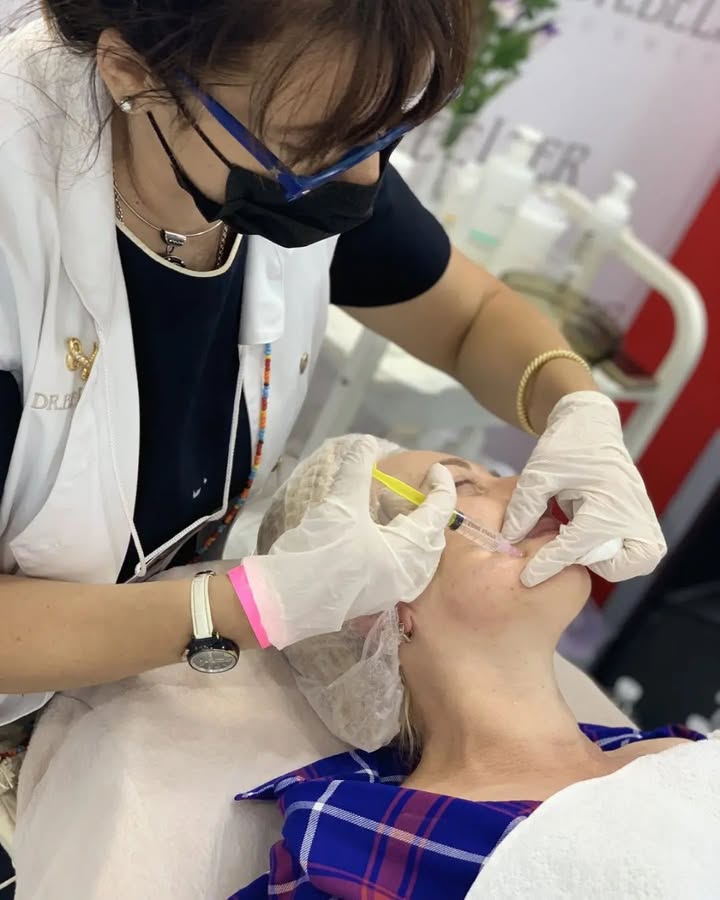

Botox and Dysport are analogues made in different countries, and both are based on botulinum toxin type A, so they work the same way: they relax the facial muscles and wrinkles smooth out. The main difference is the dosage: Botox has a higher concentration of botulinum toxin, so more Dysport is needed for the same effect. The excipients differ too.
Dysport vs Botox: what is the difference?
Dysport is a botulinum toxin type A product made by Ipsen; Botox is a product of the same type made by Allergan. They have the same active substance and work the same way, so they are analogues rather than a "stronger and weaker" product. They differ in the country of manufacture, the botulinum toxin concentration and the excipient.
| Botox | Dysport | |
|---|---|---|
| Country | USA | France and United Kingdom |
| Manufacturer | Allergan (part of AbbVie since 2020) | Ipsen |
| Active substance | botulinum toxin type A | botulinum toxin type A |
| Botulinum toxin concentration | higher | lower — more is needed for the same effect |
| Excipient | sodium chloride | lactose |
| Which to start with | doesn't matter | doesn't matter |
How the products work
Both products block neuromuscular transmission: the muscles stop responding to the nerve impulse sent by the brain. The facial muscles relax, and wrinkles smooth out or disappear completely. The mechanism is the same for both, because the active substance is the same — botulinum toxin type A.
Differences in dosage and composition
The main difference is the dosage. Botox has a higher concentration of botulinum toxin than Dysport, so you need more Dysport for the same effect. That is why the number of units of one product can't simply be compared with the other: the doctor calculates the dose for a specific product and a specific face.
Each brand has its own formula: Botox uses sodium chloride as the excipient, Dysport uses lactose. For a patient without allergies this makes no real difference.
Which to start with and why alternate
It doesn't matter which product you start with. Alternating is possible to prevent resistance: one or two years on one product, then on the other. Tolerance to botulinum toxin develops over 10–15 years, so alternating is a strategy for years ahead.
By alternating the products we "trick the body" and get the desired result — blocking the motor function of the muscles. Botox and Dysport can and should work together, backing up and replacing each other as tolerance develops.
How to prepare
For a lasting result it is important to prepare the body — we discuss this at the consultation. There the doctor also checks contraindications, allergies and your previous experience with injections, and chooses the product. You can book a consultation with cosmetologist Larysa Lonchar.
Another popular injectable treatment is lip filler; on volume and frequency see Lip Filler: How Many ml and How Often?
For aesthetic doctors — the master class "Botulinum Therapy for Difficult Faces. Complications of Botulinum Therapy": asymmetries, myofascial syndrome, patient selection.
First published on the Biotonika school Facebook page on 09.01.2023. Updated 09.10.2026.
Questions and answers
What is Dysport?
Dysport is a botulinum toxin type A product made by Ipsen, an analogue of Botox. It relaxes the facial muscles, and wrinkles smooth out.
Which is better, Botox or Dysport?
They are analogues that work the same way. The main difference is the dosage, and it doesn't matter which one you start with.
Why does Dysport need more units?
Botox has a higher concentration of botulinum toxin, so more Dysport is needed for the same effect. Doses of the two products don't convert one-to-one — the doctor calculates them.
How do Botox and Dysport differ in composition?
Botox contains sodium chloride as the excipient, Dysport contains lactose. For a patient without allergies this makes no real difference.
Why alternate Botox and Dysport?
To prevent resistance: one or two years on one product, then on the other. Tolerance to botulinum toxin develops over 10–15 years.